
Can You Turn the Car You Already Own Into an Electric One?
For most drivers, moving to electric means replacing the car. Retrofit companies are working on another option: remove the petrol or diesel drivetrain, install an electric motor and battery, and keep driving the vehicle you already know.
Europe has a replacement problem as much as a technology problem. Around 256 million passenger cars were on EU roads in 2024, while electrically chargeable cars accounted for only 3.7 percent of the fleet. New registrations are changing much faster: battery-electric cars reached 20.7 percent of the EU new-car market in the first half of 2026.
Those two numbers describe very different realities. Manufacturers are selling more electric cars, but the existing fleet turns over slowly. Cars in the EU remain on the road for around twelve years on average, which leaves millions of petrol and diesel vehicles in daily use long after electric models have entered showrooms.
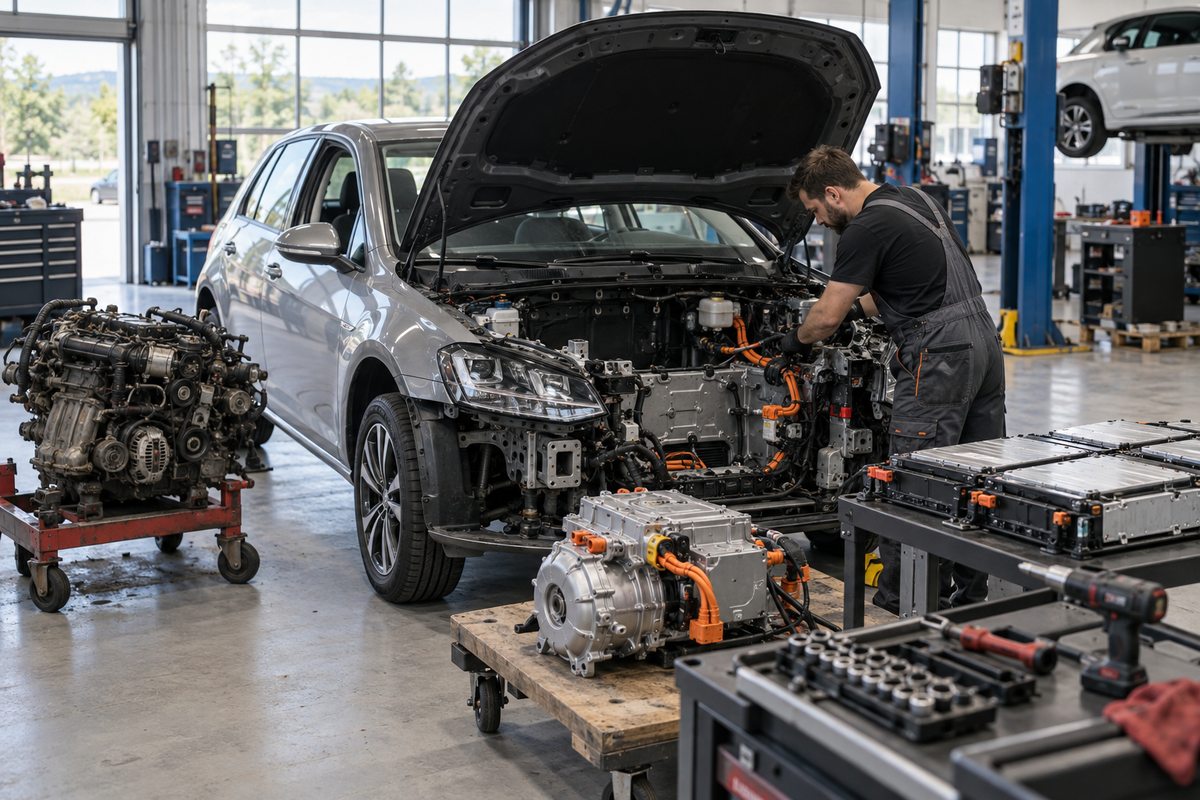
An electric retrofit starts with those cars. The workshop removes the combustion engine, fuel tank and exhaust-related components. An electric motor takes over propulsion, while a battery pack, inverter, charger, high-voltage wiring and control electronics have to fit into a body designed around an entirely different drivetrain. Engineers then integrate the new components with the brakes, cooling system, dashboard and existing electronics before the converted car returns to the road.
For the owner, the attraction is simple. You keep the body, interior and much of a car that has already been manufactured and paid for. The difficult part begins with deciding whether that particular car deserves the investment.
A €12’500 conversion changes the calculation
Electric conversions are not new. Classic-car owners have commissioned them for years, often spending enough that economics came second to keeping a favourite vehicle on the road.
Mass-market cars impose a harder test. A retrofit costing €25’000 makes little sense on a ten-year-old hatchback worth a fraction of that amount. Fraunhofer ISI has examined the economics using the Volkswagen Golf 7, one of Europe’s most common used cars. Its analysis assumes a retrofit cost of around €15’000. German company E-Revolt says it has brought its proposed conversion price down to about €12’500, including a two-year guarantee.
The work involves more than fitting a motor in the space left by the engine. E-Revolt removes the combustion equipment and installs the electric drive, battery and high-voltage hardware. The company has received enquiries for VW Golfs as well as Audi A2s, Volvo V70s and BMW 3 Series cars.
A Golf provides the more convincing industrial case because there are so many of them. Germany alone has around 2.4 million registered Golf 7s from model years 2012 to 2021. Engineers can design one conversion around a known platform, establish where the battery goes, how the added weight affects the chassis and how the electronics communicate, then repeat much of that work on the next car.
Converting a different model every day produces a bespoke workshop business. Converting hundreds of similar cars begins to resemble manufacturing.
The environmental argument depends on keeping the existing car
Fraunhofer calculated that converting Germany’s 2.4 million Golf 7s would avoid around 2.76 million tonnes of CO₂ each year. Its model assumes annual driving of 14’000 kilometres. A converted petrol or diesel Golf charged using the German electricity mix saves around 1.15 tonnes of CO₂ annually. Charging it entirely with solar electricity raises the saving to about 1.9 tonnes.
Part of the case comes from avoiding another complete vehicle build. Steel, glass, seats, dashboard, doors and much of the chassis already exist. Retrofitting replaces the system responsible for propulsion rather than manufacturing an entire car around a new one.
That logic weakens when the donor car is already near the end of its life. Spending €12’500 or €15’000 on a vehicle that soon needs structural repairs, suspension work and other expensive maintenance merely postpones replacement.
The first serious retrofit decision therefore happens before the conversion quote. A workshop has to assess the car as an asset, not just as a container for an electric motor. A six-year-old Golf with a sound body and complete service history has years of use left. A heavily worn fifteen-year-old car may not.
France has already made retrofit a recognised route to electrification
France gives owners a clearer legal path than most European markets. Since 2020, French rules have explicitly allowed approved professionals to convert combustion vehicles to battery-electric or hydrogen power. A passenger car generally needs to be more than five years old and must use an approved retrofit system. The installer handles approval of the conversion kit, while the owner subsequently updates the vehicle registration and informs the insurer.
That changes the nature of the proposition. A French owner is not commissioning an experimental modification and then discovering whether the authorities will accept it. The regulatory system already recognises electric retrofit as a vehicle category.
The country also provides the sort of fleet on which the idea depends. France has tens of millions of passenger cars in circulation, and used-car transactions comfortably outnumber new-car sales. An owner of a seven-year-old Peugeot, Renault or Citroën is already accustomed to valuing the remaining life of an existing car rather than treating new-car replacement as the default.
French low-emission zones add another reason to investigate conversion. An approved electric retrofit changes how the vehicle is classified for urban emissions restrictions. For someone who likes the car, has maintained it properly and needs continued access to restricted areas, the comparison is no longer simply retrofit versus keeping the petrol engine. It includes selling the car and finding a replacement.
Price still decides whether the arithmetic survives. If a suitable used EV costs little more than the conversion, keeping the old vehicle needs another reason: condition, familiarity, body style, sentimental value or a use case that the available second-hand EVs do not meet.
Switzerland makes the engineering possible, but approval matters from the start
Switzerland has almost 4.84 million passenger cars on the road. Only around 249’800 were fully electric in 2025, equal to 5.2 percent of the fleet. The average Swiss car is now 10.8 years old. Those numbers create the same basic opportunity as the EU: a relatively new electric market sitting beside millions of combustion cars that remain usable.
Swiss rules have also been adjusted to make the technical approval of combustion-to-electric conversions more realistic. Earlier requirements could force retrofit developers to provide electrical-safety evidence through tests designed for newly manufactured vehicles, including destructive tests. The revised rules allow recognised testing bodies to use alternative procedures when installers use appropriately approved high-voltage components and demonstrate equivalent safety.
A Swiss conversion therefore starts with the approval path as well as the battery size. An owner considering an older BMW, Volvo or Volkswagen needs to know whether the chosen conversion has the necessary technical documentation, which recognised testing body will assess the installation and what the cantonal road authority will require before changing the vehicle documents. The workshop that merely says it knows how to make the car move under electric power has not completed the job.
Switzerland also exposes one of the economic weaknesses of retrofit. Labour is expensive. A system that requires extensive fabrication and troubleshooting on every car quickly becomes difficult to justify against a used EV. Standardised kits matter even more in that market.
What actually changes inside your car
The engine is the obvious component to disappear, but it is not the hardest part of the project. Battery placement usually drives the design. Engineers need enough capacity to give the car acceptable range without adding excessive mass or compromising crash protection. An old fuel-tank space alone rarely provides enough room, so battery modules may occupy several locations around the vehicle.
Weight then affects springs, dampers, brakes and permitted axle loads. The cooling system changes because batteries, motors and power electronics have different thermal requirements from a combustion engine. The car also needs a charging inlet and onboard charger.
Modern cars create another problem through electronics. The instrument cluster expects information from an engine control unit that no longer exists. Stability systems, power steering, air conditioning and other equipment may depend on signals travelling across the vehicle network.
A good retrofit kit therefore replaces far more than the source of torque. Owners should expect the workshop to explain battery capacity, estimated real-world range, charging speed, added or removed weight, warranty coverage and which original systems remain fully functional. A conversion that leaves warning lights on the dashboard or disables safety equipment is not a credible shortcut to electrification.
Range does not need to match a new EV for every owner
A retrofit faces physical limits that manufacturers designing a new EV do not have. A purpose-built electric platform reserves a large area in the floor for batteries. A converted car has to work around an existing structure.
That usually means accepting a smaller battery. For someone driving 40 kilometres a day and charging overnight, a moderate battery may be entirely adequate. Installing enough cells for 500 kilometres of range adds cost and weight that the owner rarely uses.
A second car used for local journeys presents another plausible case. So does a company vehicle that follows a predictable route and returns to the same depot every evening.
Long-distance drivers have a harder decision. If the conversion delivers modest range and slow charging, a used factory-built EV may serve them better.
Retrofit works best when the owner starts with actual mileage rather than asking the converted car to reproduce every capability of the petrol version.
The car needs enough remaining life to repay the conversion
A €12’500 retrofit spread across another eight years of ownership looks very different from the same investment followed by a sale two years later.
Annual mileage matters for the same reason. Electric propulsion reduces energy costs per kilometre, especially for households charging at home. Owners with rooftop solar improve the calculation further. Maintenance also loses oil changes, exhaust-system repairs and several combustion-specific components.
Someone covering 20’000 kilometres annually has far more opportunity to recover part of the conversion price than someone driving 4’000.
The vehicle’s resale value remains less predictable. Factory-built EVs have established model histories, dealer networks and standard specifications. A converted car depends more heavily on the reputation of the kit supplier, the installer, available replacement components and documentation.
A cheap conversion from a company that disappears in three years creates a different ownership risk from an approved system supported by a supplier that can still provide batteries, control electronics and software.
Europe has enough cars. It needs repeatable conversions
The EU fleet gives retrofit an enormous theoretical market. Converting just 1 percent of its roughly 256 million passenger cars would mean more than 2.5 million vehicles.
The realistic market is far smaller because many cars fail the economic test before engineers touch them. Suitable candidates share a few characteristics. They exist in large numbers, remain structurally sound, have enough expected life left and cover enough kilometres to benefit from cheaper electric operation. A retrofit company also needs a repeatable kit for the model rather than redesigning the conversion around each individual vehicle.
That puts cars such as the Golf at the centre of the argument, but the same logic could apply to other high-volume European platforms once suppliers develop approved packages for them.
France shows what happens when regulation gives those packages a defined approval route. Switzerland shows why technical rules need to accommodate vehicles that were never designed as EVs. Germany provides a test of whether a €12’500 conversion can move from workshop prototype towards a repeatable commercial service.
For an owner, the decision is narrower than Europe’s decarbonisation debate. Start with the car in the driveway. Check its age, condition, annual mileage and expected years of further use. Find out whether an approved conversion exists for that exact model and what range the available battery delivers. Then compare the complete conversion bill with the used EVs available for the same money.
A healthy seven-year-old car that you intend to keep for another decade gives retrofit a case to make. A worn car that you were already planning to replace does not need an electric motor. It needs replacing.

