Body Scans: What Happens When You Look for Disease Before Symptoms
Private clinics in Switzerland will scan a healthy body from head to toe before symptoms appear. The technology is impressive. Knowing what to do with everything it finds is harder.
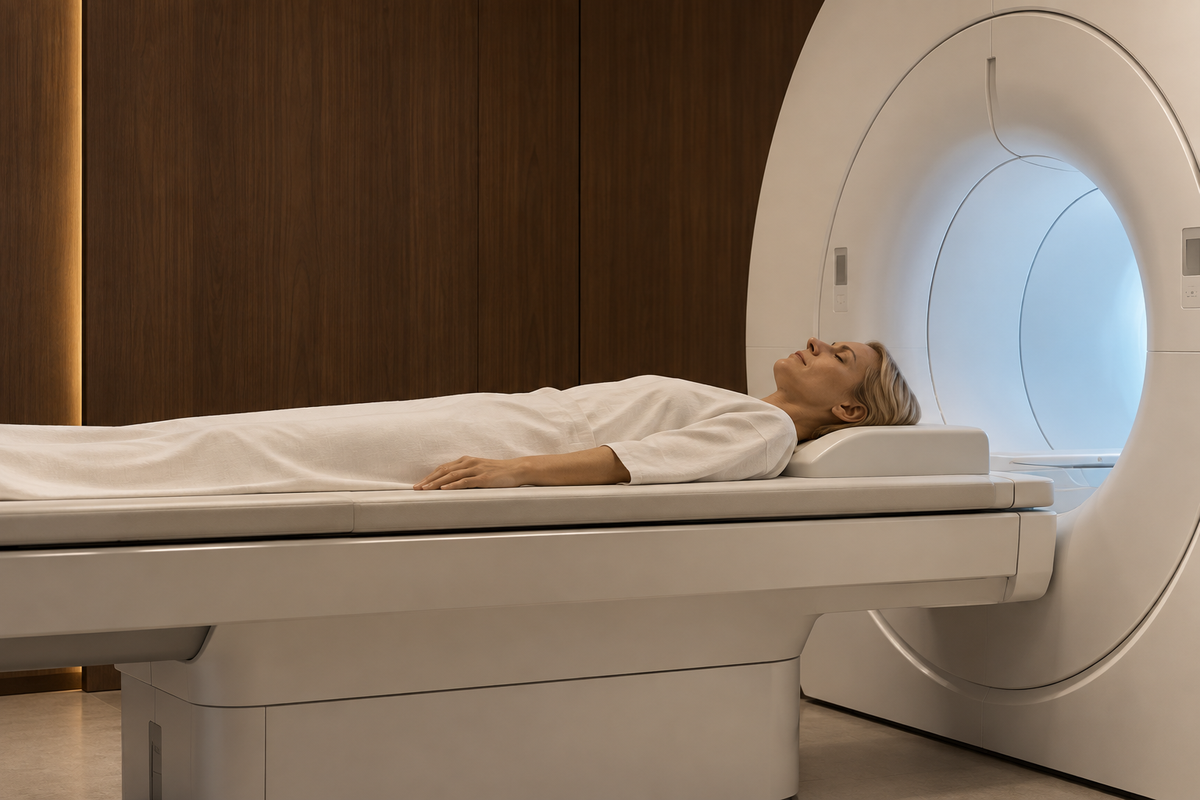
You can now walk into a private clinic in Switzerland without feeling ill and pay to have much of your body searched for disease. At Tamina Health in Bad Ragaz, a whole-body MRI costs CHF 1’990. Life Style Imaging charges CHF 2’450 for a 60-minute whole-body MRI, or CHF 2’950 with an extensive blood analysis. Revoscan starts at CHF 4’500 and runs to CHF 7’800 for a package combining a whole-body MRI with blood tests, bone-density imaging and, at the top end, a cardiac CT and calcium score.
People are paying for something conventional check-ups rarely offer: a detailed look for disease before symptoms appear. Instead of waiting for a symptom and then examining one part of the body, the scan looks for trouble before you know it is there. Tamina Health markets its MRI as a way to detect changes before symptoms appear. Life Style Imaging lists cancers, cysts, aneurysms and fatty liver among the conditions its scan looks for. Revoscan says its MRI produces 6’000 to 7’000 images and searches for more than 500 conditions. None of the MRI examinations uses ionising radiation.
It sounds like a persuasive version of preventive medicine: look harder, find disease earlier, treat it sooner. Body-scanning businesses have built much of their appeal around that sequence, helped by a wider culture in which health is increasingly something to measure, track and optimise. Blood glucose, sleep, heart rate and body composition already arrive as numbers on a phone. An MRI takes the idea much further. For an hour, the healthy body becomes something that can be searched. Swiss radiologists are less convinced that searching more widely always produces a better result.
When the scan finds exactly what you paid it to find
The Swiss Society of Radiology, SGR-SSR, currently takes a critical view of whole-body MRI for healthy people without symptoms or another clinical indication. The society says there is still no robust evidence that routinely scanning asymptomatic people improves their long-term health. It also puts a number on one of the problems: incidental findings appear in up to 30 percent of whole-body MRI examinations, although reported rates vary according to how researchers define them. Most are harmless.
An incidental finding is something the scan was not specifically looking for. It might be a cyst, nodule, unusual patch of tissue or other anatomical change. Once a radiologist sees it, however, somebody has to decide whether it deserves another look.
The adrenal glands show how quickly the logic becomes awkward. More than 95 percent of adrenal incidentalomas are benign, according to the SGR-SSR. Yet an uncertain image can still lead to more imaging, blood tests or a biopsy before doctors know which side of that 95 percent a patient belongs on. Some follow-up examinations involve radiation or an invasive procedure even though the original MRI did not.
For the person being scanned, the result is no longer simply a reassuring report saying that everything looks normal. A small abnormality now has a name, a place on an image and perhaps a follow-up appointment six months later.
There are occasions when that process finds something important. The SGR-SSR acknowledges cases in which whole-body imaging has identified disease early enough to make treatment easier. Finding an aneurysm or malignant tumour before it causes symptoms is precisely the result people hope they are paying for. The problem is that medicine cannot yet reliably separate those valuable discoveries from all the abnormalities that would never have harmed the person carrying them.
Finding more cancer is not the same as preventing more deaths
South Korea offers one of the clearest examples of how aggressively looking for disease changes the numbers.
Between 1993 and 2011, the country’s rate of thyroid-cancer diagnosis increased 15-fold as thyroid screening became widespread. Thyroid-cancer mortality remained essentially unchanged. Researchers writing in The New England Journal of Medicine concluded that screening had uncovered large numbers of cancers that would not otherwise have become clinically apparent.
The screening found real thyroid tumours, not false positives. The problem was not simply a faulty test giving false-positive results. Many had genuine papillary thyroid cancers that were unlikely ever to threaten their health.
That is what makes overdiagnosis different from a false alarm. A false positive eventually turns out not to be disease. Overdiagnosis finds a real abnormality or disease that would never have caused symptoms or shortened the patient’s life. Once detected, both can generate further medicine.
Whole-body MRI does not screen the thyroid in the same way as the Korean ultrasound programmes, and the example does not tell us how frequently a Swiss whole-body MRI will lead to overdiagnosis. It shows the problem created when the ability to detect disease advances faster than our ability to know which disease needs treating.
A whole-body MRI is not every MRI at once
Scanning the whole body does not mean examining every organ in diagnostic detail.Whole-body MRI has to cover a large anatomical area within a tolerable amount of time. The SGR-SSR says restrictions on scan duration and body heating mean its resolution and image quality are not necessarily comparable with a targeted MRI ordered to investigate a specific clinical problem. Whole-body screening also generally takes place without the contrast agents doctors use for some diagnostic questions.
In other words, CHF 2’450 does not buy dozens of specialist MRI examinations compressed into one hour. It buys a broad search.
Who reads that search matters too. The SGR-SSR recommends experienced radiologists with valid Swiss authorisation and, ideally, assessment by two subspecialists, such as a body radiologist and neuroradiologist. It warns that whole-body scans are not always interpreted at that level.
Price alone tells you little. Tamina Health currently charges CHF 1’990. Life Style Imaging charges CHF 2’450 and includes medical discussion of the results. Revoscan’s CHF 4’500 Essential package adds AI-assisted brain assessment and body-composition analysis to its whole-body MRI; CHF 7’800 adds blood tests, bone-density imaging and cardiac CT. Revoscan states explicitly that its preventive screening is not covered by insurance.
A person comparing clinics therefore has more to ask than how many diseases appear on the website. Who reads the images? How much time do they spend on them? Is a doctor available before and after the scan? If something uncertain appears, who decides what happens next?
Switzerland already screens healthy people – but much more selectively
None of this means medicine waits until people become ill. Swiss compulsory health insurance already pays for screening in healthy populations when evidence supports looking for a particular disease in a particular group. Since July 2025, colorectal-cancer screening has been covered up to age 74; eligible adults can use a faecal blood test or colonoscopy under the specified programme. Screening mammography is covered every two years for women over 50 when performed through qualifying cantonal or regional programmes.
The difference lies in what doctors are looking for and in whom. A colonoscopy does not inspect a healthy 40-year-old from brain to pelvis in case something appears. Mammography does not search every organ for an abnormality. Each screening programme limits the population, disease and interval because researchers have tested whether finding that disease earlier produces enough benefit to justify screening healthy people for it.
The SGR-SSR makes the same distinction when it points to targeted MRI for people with familial risks such as a BRCA mutation and low-dose CT for long-term smokers as examples of screening linked to defined risks. For healthy people without symptoms or risk factors, it says the evidence for general whole-body MRI remains insufficient.
That leaves commercial scanning in an unusual position. The machines are real, the images are detailed and some scans undoubtedly find serious disease. What remains uncertain is whether routinely putting healthy people through the process produces better health outcomes overall.
So what are you buying for CHF 2’500?
Part of the answer is information. For someone who likes seeing blood markers, sleep scores and heart-rate data, receiving thousands of images of the body has an obvious attraction. A baseline scan also creates something to compare with later examinations. Revoscan explicitly sells its CHF 4’500 examination partly as a reference point for following health over time.
But information is not the same thing as reassurance. A completely normal scan cannot guarantee that you will remain healthy. The SGR-SSR describes whole-body MRI as a snapshot: it records what is visible at that point and says relatively little about what will happen later. Equally, an abnormal scan does not necessarily mean that the abnormality will ever make you ill.
For anyone still tempted, the most useful questions come before entering the scanner. Ask exactly which parts of the body and which diseases the protocol is designed to assess. Find out who will read the images and whether that person holds the appropriate Swiss authorisation. Ask whether a second specialist reviews them, what medical consultation is included and what happens if the radiologist finds something uncertain. The SGR-SSR specifically advises people without symptoms or risk factors to discuss the idea with their GP before booking.
And do not treat an expensive private scan as permission to skip established screening. A whole-body MRI and a mammogram, colonoscopy or other targeted examination answer different medical questions.
The most seductive part of scan culture is also the part medicine has not solved. It is now possible to look inside a healthy body in extraordinary detail simply because you want to know what is there. In up to 30 percent of whole-body MRI examinations, something incidental is found. Some of those findings will prove important. Others will start a medical investigation into something that would otherwise have remained harmless and unknown.
Once you have seen it, however, it is very difficult to go back to not knowing.
Sources: Swiss Society of Radiology (SGR-SSR) position paper on whole-body MRI in asymptomatic people; Swiss Federal Office of Public Health (FOPH/BAG) information on preventive screening and compulsory health insurance; The New England Journal of Medicine research on thyroid-cancer screening in South Korea; published pricing and examination details from Tamina Health, Life Style Imaging and Revoscan. The article also draws on reporting and expert commentary published by SheerLuxe on Neko Health, Prenuvo and the growth of private body scanning.