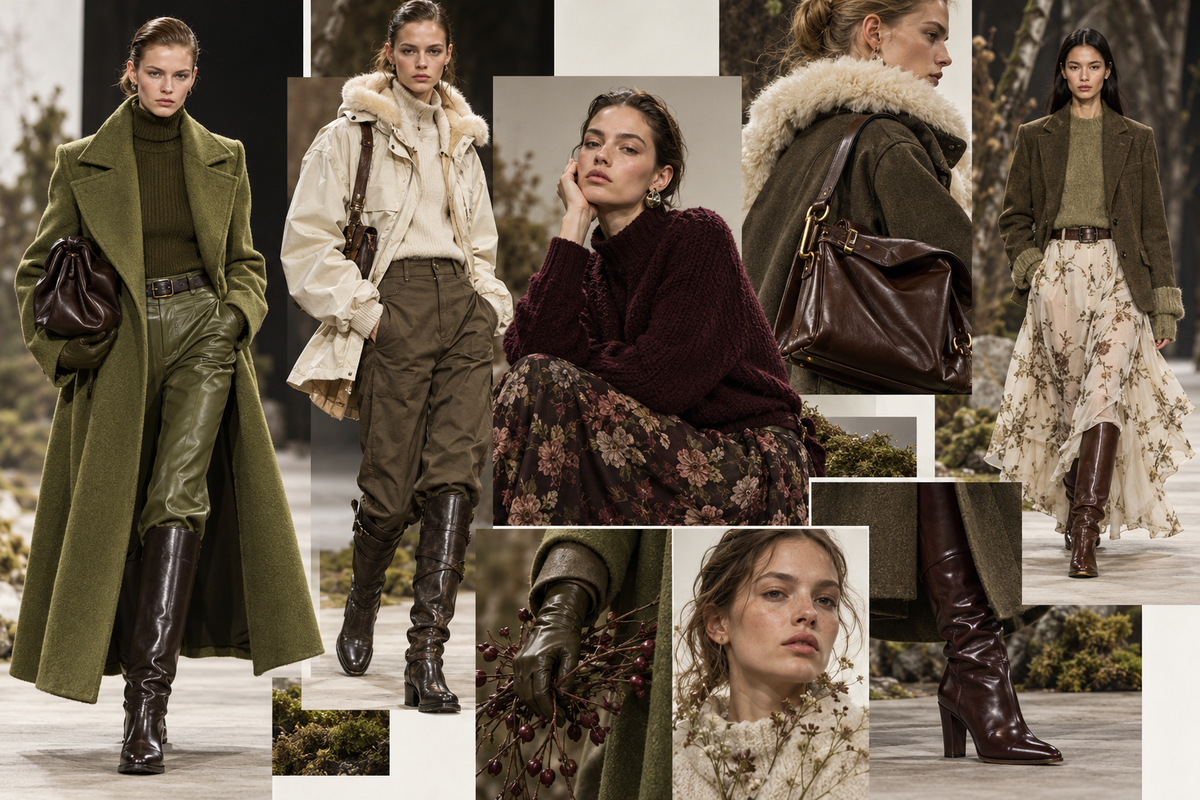
From Loden Green to Shearling: Fashion Has Gone Back to the Woods
Designers are looking to forests, mountains and outdoor clothing for autumn, bringing loden green, shearling, explorer jackets and walking boots into wardrobes that have very little to do with hiking.
Fashion has spent years borrowing individual pieces from the outdoors. Technical trainers came first, then shell jackets, fleeces and hiking shoes. Autumn 2026 goes further. Designers are not simply taking practical clothing out of the mountains and putting it into the city. They are building entire collections around the idea of nature itself.
Louis Vuitton turned the Louvre’s Cour Carrée into something resembling an alpine trail, complete with blocky green hills. Nicolas Ghesquière called the collection Super Nature and sent out clothes that treated the outdoors less as sport than as atmosphere, including bags tied to walking sticks with bandanas.
Miu Miu went into the woods too. Staff covered the runway with grass and twigs before models appeared in trapper hats and shearling-lined windbreakers. At Hermès, Nadège Vanhee created a moss-filled woodland around loden-green coats, Sixties-style knitwear, explorer jackets, salopettes and thigh-high boots. Her customer, she said, was someone who “takes control, walks in the night and charts new territory”.
It was less campsite than very expensive walking holiday. The same idea moved into couture. Dior placed tree ferns around the runway and dressed models in monstera-green Bar jackets, fern-lace dresses and tailoring covered in tiny wildflower appliqués. Chanel sent flowered vines and anemone-like blossoms through its couture collection. Backstage, Bruno Pavlovsky, president of fashion at Chanel and head of the French Fashion Federation, described nature as “the ultimate luxury”.
The clothes explain what that phrase looks like in practice. Loden instead of emerald. Moss instead of bright green. Shearling rather than polished leather. Field jackets, heavy boots, substantial knitwear and colours that look as though they came from bark, soil, leaves and berries.
Start With Loden Green
If there is one colour to take from the trend, it is loden. The shade sits somewhere between olive, moss and grey-green, which is why it works so easily with autumn clothes. It has enough colour to move an outfit away from navy, black or camel, but it is quiet enough to behave like a neutral.
Hermès used it across coats and knitwear, and the colour makes particular sense in outerwear. A loden-green coat over navy trousers, a cream knit and dark-brown leather already gives the wardrobe the mood of the trend without requiring a single technical piece.
It also works with black cherry, another colour Hermès used this season. Burgundy, oxblood and dark berry all bring more depth to green than beige does, particularly in bags and shoes.
Cream and oatmeal soften it. Navy makes it sharper. Chocolate brown pushes it warmer. Pale blue works surprisingly well too, especially in shirting.
Shearling Is Back Without Looking Rustic
Shearling has always belonged to autumn, but Miu Miu’s version feels less rustic than the usual country associations. A shearling-lined windbreaker has more tension than a traditional aviator jacket because it puts warmth inside something technical. The useful part for an everyday wardrobe is the contrast: practical fabric on the outside, tactile lining underneath.
A short shearling-lined jacket is probably easier to wear than a full shearling coat. Keep the rest of the outfit simple — straight denim, tailored trousers, a fine knit — and let the texture do the work.
The same applies to boots. Tall leather boots appeared at Hermès, but the styling does not need to become literal. Wear them with a clean wool skirt or under a longer coat rather than building an entire outdoors outfit around them.
The Field Jacket Has Become Less Functional
Explorer and field jackets sit at the centre of the look because they already carry the right language: patch pockets, sturdy cotton, belts, practical fastenings.
The mistake is wearing them with everything else that belongs to the same reference. A field jacket works better over a white shirt and tailored trousers than with cargo trousers and hiking shoes. The contrast keeps it in the city. The same goes for salopettes, windbreakers and technical footwear: one outdoors piece usually has more impact than three.
Fashion has already moved beyond gorpcore’s fascination with visible performance gear. Autumn 2026 feels softer, more romantic and more interested in landscape than in equipment.
The Palette Matters As Much As The Clothes
The easiest way into the trend is through colour rather than silhouette. Loden green, moss, bark brown, black cherry, oatmeal, cream and muted floral shades can all sit inside an ordinary autumn wardrobe. None requires a dramatic styling change.
A moss knit with charcoal trousers works. So does a black-cherry bag with an olive coat. Cream softens dark green. Brown suede makes it warmer. Even a small amount of colour — socks, scarf, gloves, umbrella — is enough to shift a neutral outfit.
The fabrics matter too. Wool makes green look quieter. Satin makes it richer. Cotton keeps it utilitarian. Suede deepens almost every shade around it.
Nature Is Doing More Than Providing A Colour Palette
The timing is part of the story. The collections arrive during a period shaped by anxiety around AI, war and climate change, which makes fashion’s move towards forests, mountains and wild landscapes feel less accidental. Chloé’s Chemena Kamali described nature as something that brings people back to “instinct, freedom and connection” when the house unveiled its AW26 campaign, which placed chiffon dresses in a wildflower meadow.
Arizona Muse, model and founder of the Dirt charity, saw another side to it. She noted that sustainability funding in the private sector has been falling even as designers return to nature visually.
Fashion still produces around 92 million tonnes of textile waste each year. In 2023, only 8 percent of fibres used in textiles came from recycled sources, according to the United Nations Environment Programme.
For Muse, the argument does not stop with moss-green runways and flower appliqués. Fashion’s relationship with nature depends on what clothes do to the land that produces their fibres and dyes. Through Dirt, she is working with the Demeter Standard on regenerative textile standards and the use of natural dyes.
The contradiction is hard to miss. Fashion is selling forests, soil and wildflowers back to consumers at the same time as the industry remains one of the forces putting pressure on them.
Still, the wardrobe part is easy enough to borrow without buying into every piece. Start with loden. Add shearling, dark brown leather or one field jacket. Leave the walking stick to Louis Vuitton.