
The New German Concert Hall Music Lovers Should Know About
Between Cologne and Düsseldorf, an old industrial site has become one of Europe’s most technically ambitious concert venues. If live music is part of how you plan a trip, Monheim am Rhein now deserves a place on the map. Find out more below.
Germany hardly lacks reasons to travel for music. Berlin has the Philharmonie, Hamburg the Elbphilharmonie, Leipzig its Gewandhaus and Munich a classical calendar capable of filling an entire weekend. Monheim am Rhein is not a city normally mentioned in the same sentence.
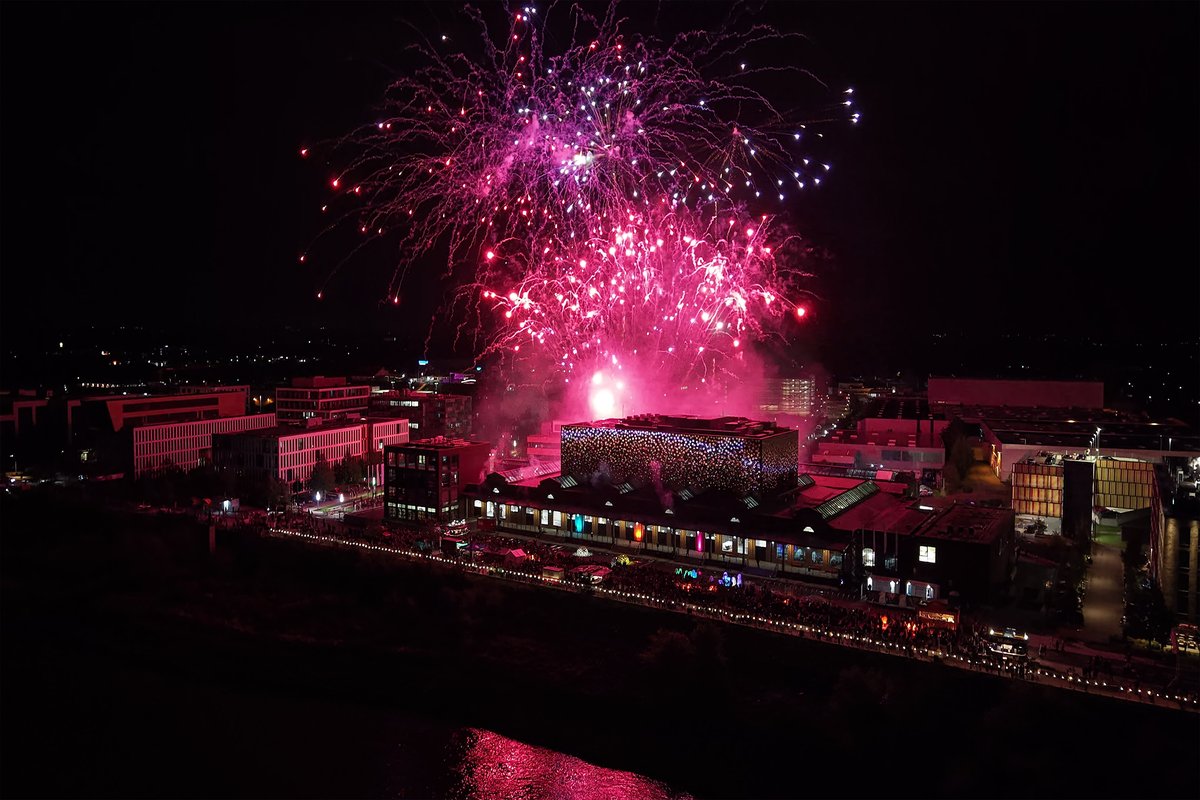
That is precisely why the Kulturraffinerie K714 is intriguing. The new venue sits in a town of around 43,000 people between Cologne and Düsseldorf. Its name comes from its position at kilometre 714 of the Rhine, while the building itself began life as a barrel-storage facility belonging to a former Shell refinery. Much of that industrial character remains. The old brick façade, visible concrete structure and distinctive roof have been kept, with a contemporary extension and glass elements inserted around them.
Inside is something far less nostalgic. K714 describes its main auditorium as the most modern concert hall in Europe, a claim built around technology rather than architectural bravado. The reverberation can be adjusted electronically, allowing the acoustics to change with the performance. Seating disappears electrically. Side walls can move. A room prepared for a symphony orchestra can be reconfigured for a standing concert, theatre production or another type of event rather than remaining fixed around one musical format.
For someone who travels for music, that makes Monheim more interesting than another handsome concert hall.
The acoustics are part of the experience
Concert halls normally come with an acoustic personality that artists learn to work with. K714 has been designed to alter its own. Electronic control over reverberation means a large symphonic work does not have to share exactly the same acoustic conditions as amplified music or a more intimate performance. At classical concerts, the auditorium seats fewer than half the 4,800 people it can accommodate for standing events. The room itself changes with the programme.
That adaptability matters if you enjoy visiting venues as much as seeing a particular performer. Much of the pleasure of travelling for a concert comes from hearing familiar music behave differently in a new room. At K714, the room is designed to become part of that equation rather than remaining constant.
The building also solves a less glamorous problem. Different areas have been acoustically separated, allowing simultaneous events without one spilling into another. A jazz performance, private celebration or other programme elsewhere in the building does not automatically compromise what is happening in the main hall.
The artists are already treating Monheim seriously
The strongest reason to pay attention is the calibre of musicians appearing on the programme. The Royal Concertgebouw Orchestra has included Monheim on a tour with pianist Víkingur Ólafsson, placing the town in an itinerary alongside Lucerne, Grafenegg, Warsaw and Paris. For artistic director Martin Witkowski, the ambition is straightforward: Monheim should become a regular stop on international touring schedules rather than a local venue waiting for whatever happens to pass nearby.
The wider programming refuses to settle into one identity. American singer-songwriter Emmylou Harris appears alongside saxophonist Branford Marsalis; regional acts sit beside classical programmes. Actor Sky du Mont has been programmed with Schubert’s Winterreise. The hall was deliberately conceived to move between a symphony orchestra and a very different sort of evening without either feeling like a compromise.
Monheim has also taken an unusually direct role in supporting musicians. Since August 2024, the city has employed the Kyiv Symphony Orchestra full-time under a three-year arrangement. Witkowski has been candid about what that means in practical terms: the musicians receive salaries from which they pay their rent and bills. The orchestra is therefore not simply appearing for a guest residency or a symbolic concert before moving on.
Go for the building as well as the programme
There is a particular pleasure in cultural buildings that retain some evidence of what existed before them. K714 has not erased its industrial history in pursuit of a pristine new concert hall.
The former refinery warehouse still reads as an industrial building from parts of the exterior. Brick, concrete and the old roofline meet a new cubic addition with glass at the façade. It has the character of a conversion rather than a replica of an old factory wrapped around an entirely unrelated interior. A visit is partly about seeing how an unglamorous piece of industrial infrastructure has been turned into a serious performance venue.
The scale is surprising too. Monheim has spent around €160 million on the conversion, far beyond the early figures discussed when the project began. The cost has attracted criticism in a municipality carrying heavy debt, and the building arrives with a political story almost as unusual as its acoustics.
You do not need to follow German municipal finance to enjoy a concert there, but the context explains why K714 feels so improbable. This is not a wealthy metropolis adding another institution to an established cultural district. It is a relatively small Rhine town deciding that a concert hall capable of attracting major touring artists belongs there.
Make it a detour rather than the whole trip
Monheim works particularly well as an addition to a journey through western Germany. It sits between Cologne and Düsseldorf, making K714 far easier to incorporate into a weekend than its relatively low international profile suggests.
Check the programme before choosing your dates rather than treating the hall as a sightseeing stop. K714 makes most sense when the architecture, acoustic technology and performer come together. A Concertgebouw evening will reveal the room differently from Branford Marsalis or an amplified concert, and that ability to change character is one of the main reasons to go.
There is also something refreshing about arriving without the accumulated expectations attached to Germany’s famous concert institutions. No obligatory photograph, no decades-old mythology about the perfect seat, no feeling that you already know the building before walking through the door.
For music lovers travelling through Germany this autumn, K714 is the kind of address worth knowing before everyone else does. Monheim may still look like the unlikely name on the itinerary between Lucerne, Warsaw and Paris. Its new concert hall was built with the intention of keeping it there.


