
Monterey’s Record Auctions Show How Selective the Classic Car Market Has Become
Nearly $750 million changed hands during Monterey Car Week in 2026, with record prices for Shelby, McLaren, Corvette and Ferrari. The week looked buoyant from the top. Further down the catalogue, buyers were far less generous.
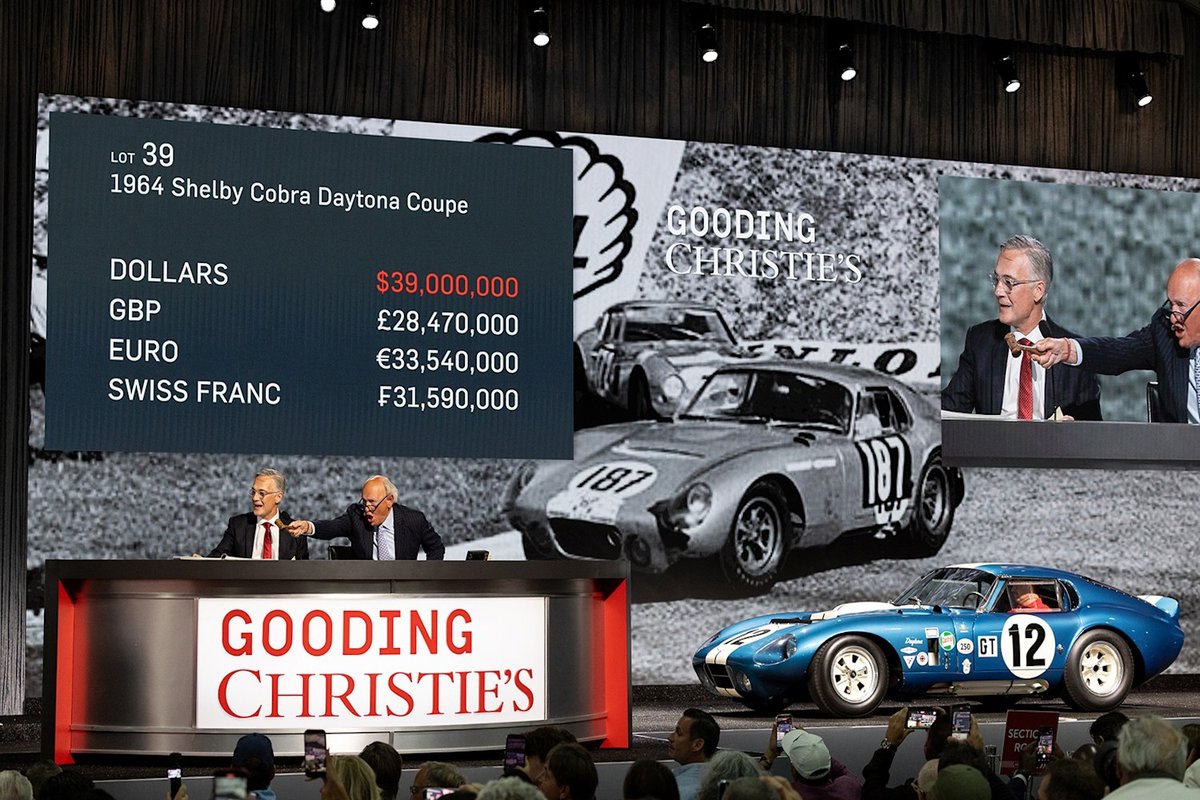
A 1964 Shelby Cobra Daytona Coupe sold for $42.9 million in Monterey, setting a new auction record for an American car. A 1996 McLaren F1 followed at $34.7 million, the highest auction price yet for a British car, while a 1963 Chevrolet Corvette Grand Sport reached $18.7 million.
Across five major auction houses, total sales reached $747.9 million. Of the 1,124 cars offered, 844 found buyers. The average sale price rose sharply, from around $529,000 a year earlier to more than $886,000.
The sell-through rate barely moved. Seventy-five percent of cars sold, against 76 percent over the comparable period last year.
That gap between stronger prices and an almost unchanged number of successful sales says more about the market than the record total. Collectors did not suddenly become willing to pay more for everything. They paid much more for a smaller group of cars.
The top end is moving away from the rest
The Shelby result sits at the extreme end of the market for good reason. Only six original Cobra Daytona Coupes were built, and the model combines racing history, scarcity and a place in American motorsport that is difficult to replicate with another car.
Most 1960s classics are trading in a different market altogether. Cars from the 1950s and 1960s made up more than a third of the Monterey offering, yet both age groups recorded median prices below condition-adjusted comparison values. Among cars from the 1960s, the median came in 6.2 percent below benchmark even while the Shelby and Corvette were setting records.
A famous badge, a correct restoration and an early registration date still bring buyers into the room. They do not guarantee that two of them will keep bidding.
For more widely available cars, collectors have choices. Another example may appear at the next major auction. A similar car may already be sitting with a dealer. Owners who price from the most spectacular result attached to the model name quickly discover how much buyers now distinguish between a good car and a difficult one to replace.
The Monterey total was therefore pulled upwards by the cars that sit outside ordinary comparison. The further a car moves from replaceable to singular, the less useful the wider market becomes in setting its price.
Ferrari remains difficult to compare with anything else
Seven of the ten highest-selling cars in Monterey wore Ferrari badges. A year earlier, the marque occupied eight of those positions.
The more revealing results came from relatively recent cars. A 1996 F50 sold for $14.6 million, a 1985 288 GTO for $11.6 million and a 1991 F40 for $8.4 million. Each established a new auction high for the model.
None belongs to the traditional image of an old masterwork preserved from the 1950s. Their buyers grew up with supercars rather than pre-war coachbuilding, and that is changing the age profile of the cars treated as serious collectibles.
Vehicles built from the 1980s through to the 2020s achieved median prices between 31 and 38 percent above previously assessed values during the week.
The money is following familiarity as much as age. A collector who spent the 1990s reading about the McLaren F1 or seeing an F40 on posters now has a different emotional reference point from someone who entered the market thirty years earlier.
Ferrari adds its own internal logic. Ownership of rare models can form part of a long relationship with the manufacturer. Established clients build histories with the marque over time, and ownership of desirable cars can matter when demand for later limited-production models exceeds the available allocation.
A car can therefore carry value beyond what happens at auction.
The McLaren F1 has already crossed the line
The $34.7 million paid for the McLaren F1 confirms something collectors have been demonstrating for several years. The car no longer sits in a provisional category called “future classic”.
The F1 combines limited production, Gordon Murray’s engineering, a naturally aspirated V12 and a central driving position that still makes the car unusual more than three decades after launch. The remaining argument is over individual examples: mileage, history, condition, specification and provenance. That is the same language long used for much older competition cars.
Monterey itself has shifted with the market. Traditional classics still anchor the week, but contemporary limited editions, hypercars and younger supercars now appear beside them without needing a separate justification. McLaren, Bugatti, Lamborghini and other modern marques have become part of the same collecting landscape.
A buyer with several million dollars to spend might now be choosing between a recognised 1960s grand tourer and a 1990s supercar. Twenty years ago, those cars occupied different worlds. Today they can compete for the same place in a collection.
Buyers have better information and more patience
Auction records are easy to search. Buyers can trace previous sales, compare chassis histories and see how often a similar specification has reached the market. A car that appeared publicly two years ago leaves a trail. So does one that failed to sell.
A rare competition history or unusual first owner can justify an aggressive estimate because the buyer may not see another comparable car for years. A familiar production model has to work harder. If several alternatives exist, there is little reason to chase one beyond its value.
Restoration quality still matters. So do matching numbers, original trim, documentation and mechanical condition. Those details establish whether the car belongs near the top of its model range. They do not automatically turn it into a record car.
The distinction becomes clearer when two outwardly similar cars come to market. One may have uninterrupted ownership records, factory colours and original major components. The other has been restored several times with gaps in its history. Both may look immaculate under auction lighting. Buyers price the difference long before bidding starts.
Rarity is becoming more specific
Production numbers remain one of the easiest ways to describe a collectible car and one of the easiest ways to oversimplify it.
Ferrari built more than 1,300 F40s. That is a substantial number beside many older blue-chip classics, yet the best F40s continue to command increasingly high prices. Buyers separate them by mileage, specification, provenance and originality, then compete when the right example appears.
The same pattern extends into smaller details. Manual gearboxes can divide demand sharply within one model line. A factory colour that rarely appears becomes more desirable when most surviving cars look alike. Original interiors matter more as heavily restored cars become easier to find.
None of those characteristics is new to experienced collectors. The scale at which buyers now discriminate between them is.
Monterey showed the consequences in the middle of the market. Cars could be attractive, well presented and historically legitimate without finding someone prepared to meet the reserve. There was still demand; the bidder simply had another price in mind.
A record week without a broad boom
The $747.9 million total will remain the headline number from Monterey Car Week 2026. It should not be mistaken for evidence that the entire classic-car market rose with it.
The strongest cars moved ahead. Ordinary examples did not follow at the same pace. That also explains why the average sale price climbed so dramatically while the percentage of cars sold barely changed. Several exceptional results changed the value of the week without changing the behaviour of the wider buyer pool.
For owners, the distinction matters when an auction estimate arrives. The highest recent sale for a model may have involved a car with history, specification or originality that another example cannot reproduce. Using it as a direct comparison can create a reserve the market has little interest in meeting.
Buyers are doing the opposite. They are looking more closely at the individual car before allowing the model’s reputation to set the price.
The next major auction will still produce records. A handful of cars will attract buyers who have been waiting years for the opportunity. Others will carry famous names, beautiful restorations and ambitious estimates into the room and leave without changing ownership.
The market is still spending. It has become much more exact about where.

