
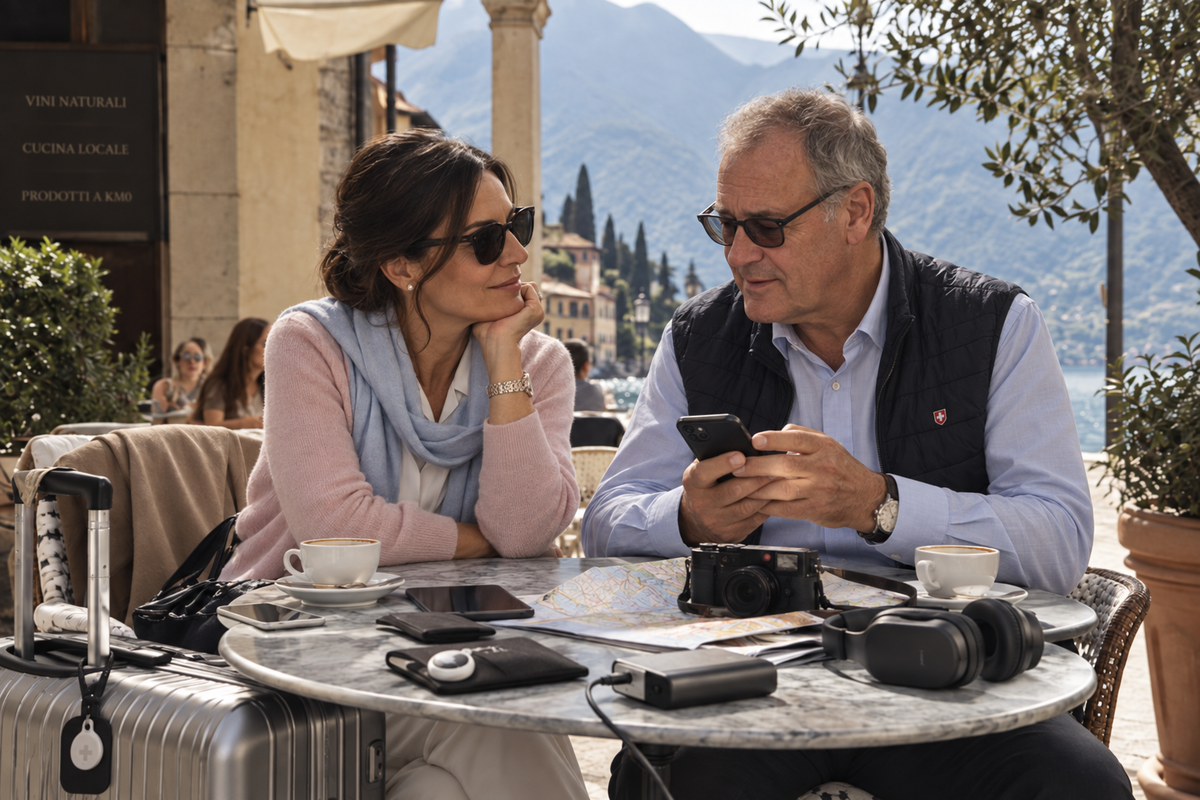
The Travel Gadgets That Have Earned A Place In Your Hand Luggage
Most travel gadgets solve problems a phone already handles. The few worth packing do something different: they find a suitcase after an airline loses it, get you online before you leave the airport, keep a phone alive during a long travel day or make eight hours of engine noise easier to tolerate.
Airports are adding more technology of their own. The Frankfurt one, for example, is testing computer vision to identify oversized cabin luggage before passengers reach the gate, while Fraport and Lufthansa already use cameras and AI to coordinate aircraft turnaround. IATA expects annual passenger numbers to exceed eight billion by 2040, putting more pressure on airports to move people and luggage faster.
The better question for travellers is simpler: which pieces of technology deserve space in the bag?
A LUGGAGE TRACKER
Apple AirTags and similar devices use networks of nearby phones and devices to report an approximate location. They do not prevent an airline from losing a bag, but they give the owner information long before the baggage desk sometimes does.
Airlines have started working with the technology rather than treating trackers as an unofficial workaround. Apple’s Share Item Location feature lets travellers temporarily share an AirTag or Find My accessory location with participating airlines during baggage searches.
A tracker makes most sense inside checked luggage rather than cabin baggage. Put it somewhere secure inside the case rather than attaching it visibly to the handle.
Worth packing if: you check luggage, change flights or travel with anything difficult to replace.
AN ESIM BEFORE YOU LEAVE HOME
Buying a physical SIM after landing used to be part of travelling outside your normal roaming area. An eSIM removes the shop, plastic card and tiny metal tool.
Travel eSIM providers now cover more than 200 destinations. Regional packages also make more sense for multi-country trips: one European or Asian plan can stay active as you cross borders rather than requiring a new SIM in every country.
Installation takes only a few minutes on a compatible phone, although activation rules vary by provider. Set it up before departure and keep your normal SIM active for calls or authentication messages if your mobile plan permits it.
Price matters less than it first appears. Check the amount of data, validity period, whether tethering is allowed and whether the plan includes calls or only mobile data. Unlimited packages sometimes apply speed restrictions after heavy use.
Worth packing if: you travel outside your normal roaming zone or visit several countries on one trip.
A POWER BANK — WITH ONE NEW RULE
A power bank remains one of the easiest ways to rescue a travel day. Boarding passes, maps, translation, hotel bookings and payment cards now depend on the same battery.
Airlines have tightened the rules around portable batteries after a series of incidents involving lithium-ion cells. International aviation guidance introduced further changes in 2026, including a limit of two power banks per passenger and a ban on recharging the power bank itself during the flight. Individual airlines sometimes apply stricter rules.
Power banks belong in hand luggage, not checked baggage. A typical unit below 100 Wh falls within standard passenger limits, while larger batteries require closer attention to airline rules.
More capacity is not automatically better. A compact USB-C model capable of charging a phone once or twice weighs less and takes up less space than a huge battery designed to power a laptop for days.
Worth packing if: your travel day regularly runs longer than your phone battery.
NOISE-CANCELLING HEADPHONES
Long-haul travel remains one of the clearest uses for active noise cancellation. Aircraft cabins produce continuous low-frequency noise, exactly the type of sound ANC handles well.
Over-ear headphones offer stronger isolation and longer battery life, while earbuds take up far less space. Current premium models also offer transparency modes for announcements and conversations without removing the headphones.
Comfort deserves as much attention as sound quality. A technically excellent pair becomes a poor travel purchase if the headband hurts after two hours or the earbuds need constant adjustment.
Battery life matters differently on a 90-minute flight and a 12-hour one. Many current over-ear models run for around a full day or longer with noise cancellation active, removing the need to recharge during most journeys.
Worth packing if: you fly regularly, work on trains or struggle to sleep with background noise.
A SMALL GAN CHARGER
Hotels still have an extraordinary ability to put one usable socket behind a bedside table.
A compact GaN charger replaces several individual plugs with one unit capable of charging a phone, tablet, watch and often a laptop. Models with several USB-C ports reduce the number of cables and adapters scattered across a bag.
Power output matters. Around 30 W is plenty for a phone; laptops often need 65 W or more. A charger promising 100 W across four ports will usually divide the available power when several devices are connected, so check the output per port rather than the number printed on the front.
For international travel, a separate plug adapter or a charger with interchangeable plugs avoids buying another adapter at the airport.
Worth packing if: you travel with more than two rechargeable devices.
SMART GLASSES ARE THE ONE TO WATCH
Smart glasses are less essential than anything else on the list, but they show where travel technology is heading.
Current models already translate conversations, give directions, identify objects and connect AI assistants to what the wearer sees. Google’s Android XR prototype displayed navigation in the field of vision and translated spoken Chinese into English. Other models offer similar functions through cameras, microphones and displays built into ordinary-looking frames.
Travel gives the technology a natural setting. A traveller can follow directions without holding a phone, hear or read translations while speaking to someone and ask for information about a building or object in front of them.
Battery life, privacy and social acceptance still make smart glasses an early-adopter purchase rather than a travel essential. Cameras and microphones also create an obvious problem around other people.
Worth packing if: you enjoy new technology and accept the compromises of an emerging category.
WHAT TO LEAVE AT HOME
Dedicated translation devices make less sense once a smartphone already runs strong translation software. Smart suitcases add weight and create battery complications for a job an ordinary suitcase plus a tracker handles more simply. Portable printers, travel routers and elaborate cable organisers solve increasingly narrow problems for most leisure trips.
Travel technology works best when it removes a task rather than adding another device to manage. A tracker solves lost luggage. An eSIM removes the search for mobile data. A power bank buys several more hours of phone use. Noise-cancelling headphones make the journey quieter. One good charger replaces several mediocre ones. Anything else needs a very good reason to take up space.
THE FIVE TO PACK
01 LUGGAGE TRACKER
For checked bags and connections. Hide it inside the suitcase and replace the battery before a long trip.
02 ESIM
Install it before departure. Compare data allowance and validity rather than headline price alone.
03 POWER BANK
Keep it in hand luggage and check your airline’s rules before flying.
04 NOISE-CANCELLING HEADPHONES
Choose comfort first, especially for long-haul travel.
05 MULTI-PORT USB-C CHARGER
One compact charger often replaces three plugs and most of the cable clutter.