Angola: Africa’s Remarkable Destination Beyond the Usual Safari Routes
Angola’s vast deserts, remote Atlantic beaches and dramatic highlands are attracting adventurous travellers. Local entrepreneurs are developing routes through a country that has long remained outside Africa’s established tourism circuit.
Angola is opening up to adventurous travellers, with local operators organising expeditions through the Namib Desert, along the Atlantic coast and into the remote southern highlands. The country offers landscapes rarely seen on conventional African itineraries, from towering dunes and abandoned coastal settlements to mountain passes and communities whose traditions reflect centuries of cultural exchange.
International tourism remained limited during Angola’s long struggle for independence from Portugal and the civil war that followed. Fighting ended in 2002, but damaged infrastructure, poverty and poor transport links continued to restrict travel across much of the country.
More than two decades later, Angolan entrepreneurs are developing small-scale tourism businesses, arranging guided expeditions, mobile camping and visits organised with local communities. Unlike neighbouring Namibia, Botswana and South Africa, where safari lodges and established touring routes cater to international visitors, Angola has relatively little tourism infrastructure outside its main cities.
Travellers therefore depend more heavily on experienced local guides, particularly in the south, where some of the country’s most striking landscapes lie hundreds of kilometres apart.
Where the Desert Meets the Atlantic
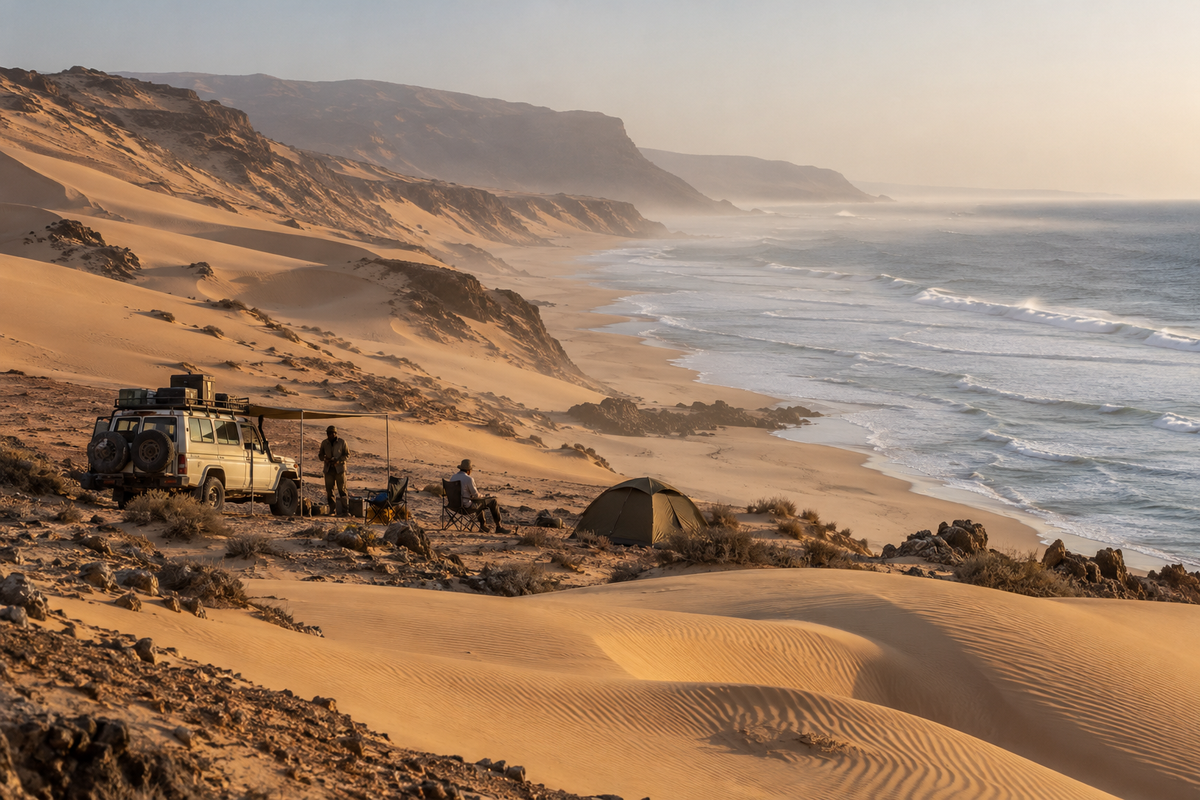
The Namib Desert extends north from Namibia into southern Angola, where enormous dunes descend towards the Atlantic. Along the coast south of Moçâmedes, sand, sea and largely untouched beaches form one of the country’s most distinctive landscapes.
Moçâmedes serves as a starting point for expeditions into the region. Beyond the city, four-wheel-drive vehicles are often needed to reach isolated beaches, desert camps and areas where wildlife moves with little human disturbance.
Oryx and jackals inhabit the dry terrain, alongside the remarkable welwitschia, a desert plant whose long, twisted leaves can survive for centuries in exceptionally dry conditions.
Further south lies Baía dos Tigres, a former fishing settlement that became an island when a storm breached its connection to the mainland in 1962.
During Portuguese colonial rule, the settlement supported a community with a school, church, post office and other public buildings. After access to fresh water was lost, residents eventually abandoned the town, leaving its buildings exposed to wind, salt and drifting sand.
Seals now gather near the ruins, while pelicans and other seabirds frequent the surrounding coast. The abandoned settlement, set against the Atlantic and spreading desert, offers an unusual glimpse of Angola’s colonial past.
Reaching Baía dos Tigres requires careful planning. Boat access depends on tides and weather, and visitors generally travel with specialist operators familiar with the coastline.
The Mountain Landscapes Around Lubango
Inland from the desert, the terrain rises towards Lubango, where cooler highlands and steep cliffs provide a marked change from the coast.
The Serra da Leba mountain pass winds through a series of tight bends, following the contours of the mountainside. Nearby, Tundavala Gap opens onto a vast drop overlooking the plains below, making it one of southern Angola’s most dramatic viewpoints.
The landscape also bears traces of the country’s political history. Tundavala was used as an execution site during periods of political violence, although the area is now better known for its scenery and walking routes.
Travelling between these landmarks involves considerable distances, often on rough or unpaved roads. Visitors need reliable vehicles, local knowledge and enough flexibility to accommodate changing conditions.
For specialist tour operators, the lack of established infrastructure presents an opportunity to develop itineraries that connect places few international travellers have seen. It also makes experienced guides essential.
Local Entrepreneurs Are Opening New Routes
Adilson Leão and Jessé Manuel founded Okuya Adventures after leaving careers in civil engineering and photography. Their business organises expeditions through Angola’s remote regions, combining four-wheel-drive travel, mobile camping and visits arranged with local communities.
The company grew out of the founders’ own journeys during the pandemic, when they began exploring parts of Angola that were unfamiliar even to many residents.
Their expeditions use temporary camps equipped for extended stays in remote areas, allowing travellers to reach places with little or no conventional accommodation.
Leão and Manuel also work with local guides and community leaders. Such arrangements bring tourism income to people who might otherwise receive little benefit from international visitors, including drivers, craftspeople and families hosting expeditions.
Angola has considerable ambitions for tourism as it seeks to reduce its reliance on oil revenues. The government has invested in a new international airport outside Luanda, while private operators are beginning to develop accommodation in natural settings and guided travel experiences.
Roads, accommodation and visitor services are limited across much of the interior, and building a reliable tourism business requires considerable planning and resources. Smaller operators such as Okuya are filling some of those gaps by organising transport, equipment and local contacts themselves.
Travelling Through Angola’s Living Cultures
Southern Angola is home to communities with distinct languages, customs and forms of dress, including the Himba, Mucubal, Mwakahona and Vátua. Many live in areas close to the Namibian border, where pastoral traditions and local trade have shaped everyday life.
Tourism offers these communities opportunities to earn income, but visits need careful organisation. Elsewhere in Africa, poorly managed cultural tourism has sometimes encouraged communities to perform traditions for visitors, reducing complex societies to displays of clothing and ceremony.
Okuya Adventures has sought to avoid that approach by developing relationships with traditional leaders, known as sobas, employing local guides and arranging opportunities for residents to sell handicrafts.
Such visits allow travellers to learn about contemporary life as well as local traditions, while giving communities greater control over how they receive visitors.
Many rural communities remain poor despite Angola’s considerable natural resources, and access to education, healthcare and other services varies widely.
Tourism cannot overcome those disadvantages on its own. Carefully managed visits can, however, provide additional income and opportunities for local businesses without requiring communities to abandon their way of life.
Luanda Offers a Different Perspective
Angola’s capital reveals another side of the country. Luanda combines Portuguese colonial buildings, modern commercial districts, informal settlements and a waterfront lined with restaurants, bars and leisure venues.
Oil wealth has helped finance parts of the city’s development, although living standards remain sharply divided. Wealthy neighbourhoods and expensive restaurants sit within a capital where many residents depend on informal trade and lack reliable public services.
Music and contemporary art offer a closer view of everyday life. Angola is the birthplace of kizomba, the musical and dance tradition that has spread internationally, while local artists draw on the city’s streets, history and social divisions.
Musseke Smart, a community-based initiative founded by entrepreneur Delfim Lemos and architect Pedro Cidade, organises visits to neighbourhoods seldom included in conventional sightseeing programmes.
In Rangel, informal markets occupy narrow streets, small businesses operate from modest premises and music plays an important part in daily life.
Artist Vopsi Moma is among the creative figures associated with the neighbourhood. His paintings combine scenes from Luanda’s streets with abstract imagery, reflecting both the city’s social conditions and his own experiences.
Community-led visits offer a perspective that conventional tours of the capital may overlook. As elsewhere in Angola, experienced local guides are important, particularly in districts unfamiliar to international travellers.
What Travellers Should Know Before Visiting Angola
Angola is best suited to experienced travellers who are comfortable with remote conditions and itineraries that may change at short notice.
Distances between destinations are substantial, especially in the south, where roads are frequently unpaved and accommodation can be difficult to find. Specialist operators arrange transport, camping equipment, guides and access to remote locations.
The dry season, broadly from May to October, generally offers better conditions for travelling through southern Angola, although coastal fog, strong winds and considerable temperature differences can still affect journeys.
Visitors should arrange comprehensive travel insurance, obtain appropriate health advice and establish reliable emergency arrangements before departure. Crime, poor roads and the continuing presence of landmines and unexploded ordnance pose serious risks in certain areas.
Many european foreign offices and ministries advise against all but essential travel to specified parts of Angola and recommend careful planning for journeys outside major urban centres. Travellers should check the latest advice before making arrangements.
Accommodation ranges from established hotels in Luanda to smaller coastal properties and organised mobile camps. Those expecting the extensive network of luxury safari lodges found elsewhere in southern Africa will have considerably fewer choices.
Angola’s appeal rests instead on its landscapes, cultural diversity and the opportunity to explore places that have received relatively few international visitors. From the desert coast to the highlands and Luanda’s neighbourhoods, local operators are gradually making those journeys possible.